More efficient
One login replaces ten. Pre-built templates replace custom quotes. One campaign setup serves every channel, every client.
10 → 1 tools replacedStop paying for ten platforms. Present omni-channel campaigns your competitors can’t replicate — under your brand, on your clients’ data. Pre-built templates across every vertical, sub-accounts that never show our name, and the postal stack your clients didn’t know they needed.
DirectMail.io runs under your brand end-to-end. Sub-accounts for each client, your agency logo, your custom domain. Clients log in to your portal — not ours.
Your logo, your colors, your domain. Clients log into your brand, not ours.
Each client gets their own workspace. Usage, lists, and reporting stay separated.
Run the platform on clients.youragency.com. DirectMail.io never appears.
Agency admins, account managers, and client users — each with the right scope.
PDF, email, and dashboard reports go out under your agency brand.
Buy wholesale, resell at your margin. The platform stays invisible to the client.
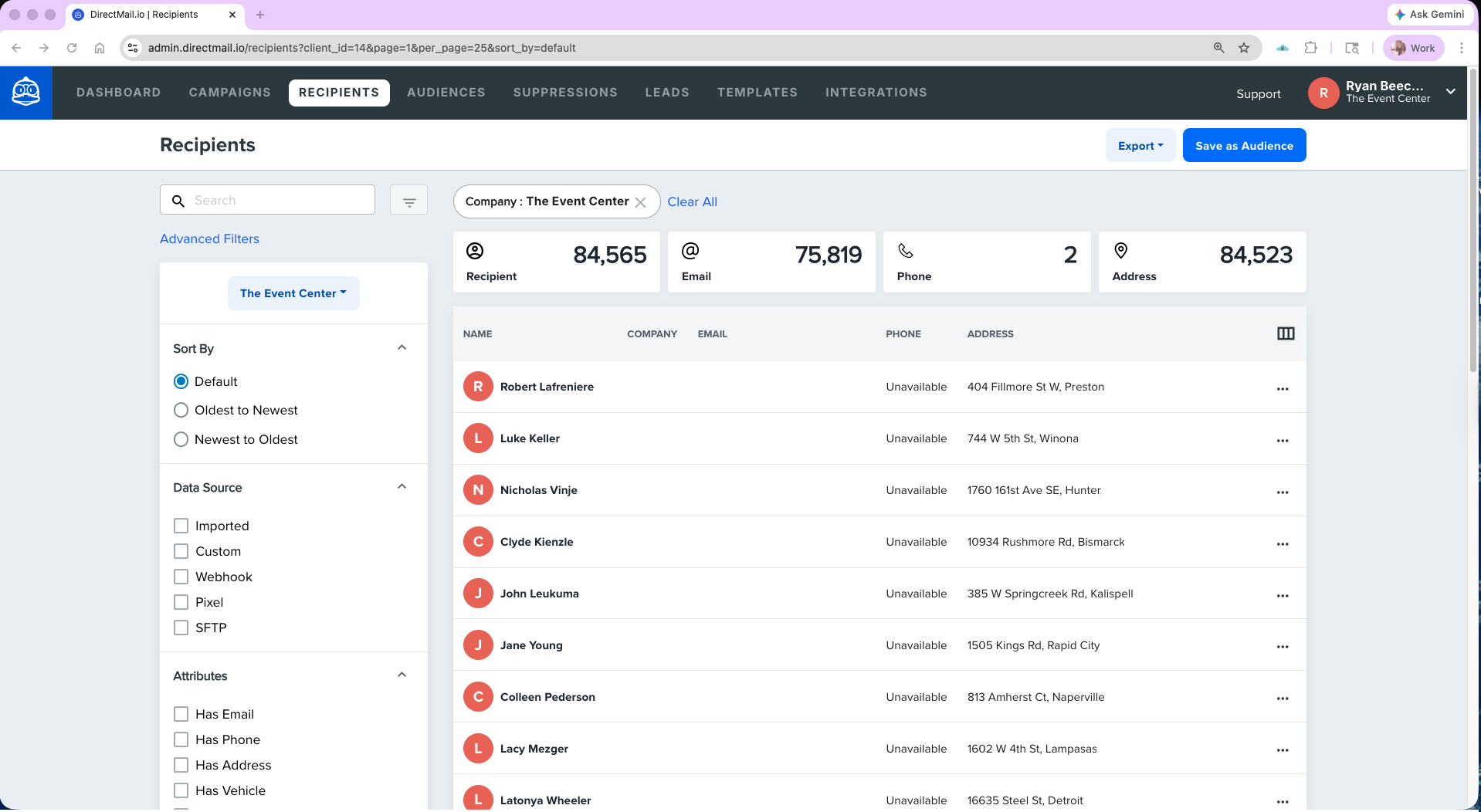
Your campaign prints at shops local to each recipient cluster — automatically. No vendor RFPs. No capacity negotiations. No quality deltas between runs. Every piece ships from close to its destination, which captures USPS drop-ship postage economics by default and shortens delivery windows.
One campaign prints across ten cities at once. Routing happens at the recipient level — the system picks the right shop for each cluster automatically.
Mail inducted at the USPS facility closest to the recipient captures the Destination Entry Discount — up to 5.5¢ per piece back on qualifying Marketing Mail, flowing through on every drop.
Every shop in the network is certified on the platform for spec, stock, and color management. The campaign reads as one brand across every press that touches it.
No RFPs. No capacity calls. No onboarding a new printer when the last one hits load. Your team runs the campaign; the network runs the production.
Source: U.S. Postal Service, Marketing Mail Destination Entry Discount schedule, 2024 — the postage savings cited above reflect USPS rate differences between origin entry and destination-entry facilities.
One campaign. Every channel. One list. Direct mail is the anchor; email, SMS, Meta, dynamic QR, and retargeting wrap around it. The USPS Scan Trigger fires email the moment USPS scans the mail — inbox and mailbox land the same day.
Email auto-fires on the actual USPS last-scan event. Inbox and mailbox land the same day.
Email, SMS, Meta, and retargeting all run on the same list as the mail drop.
1:1 QR codes tied to variable landing pages. Every scan is attributed.
Mail to anonymous web visitors. Pixel matches traffic to postal records.
Response tied to each channel, each campaign, each piece. Nothing to stitch.
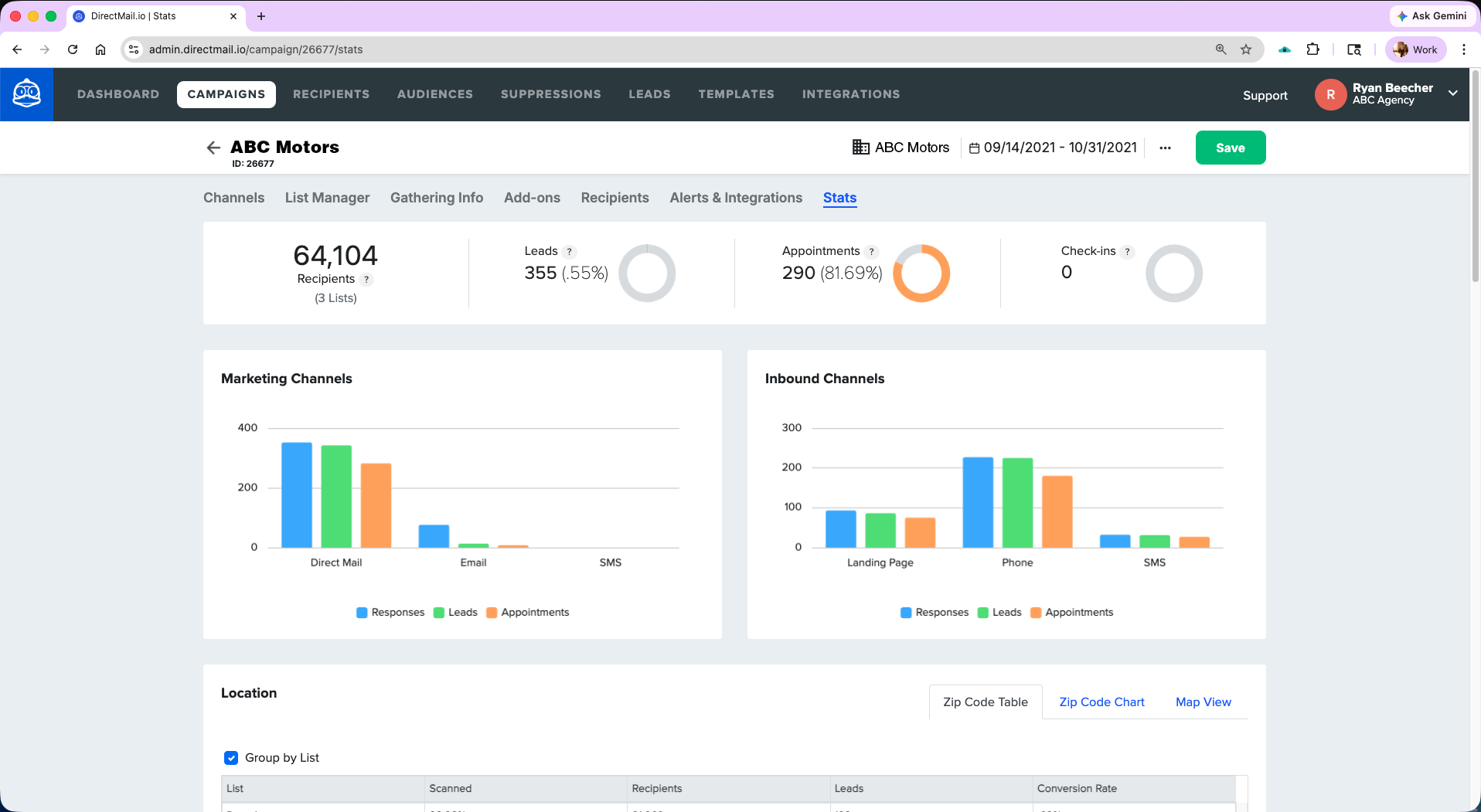
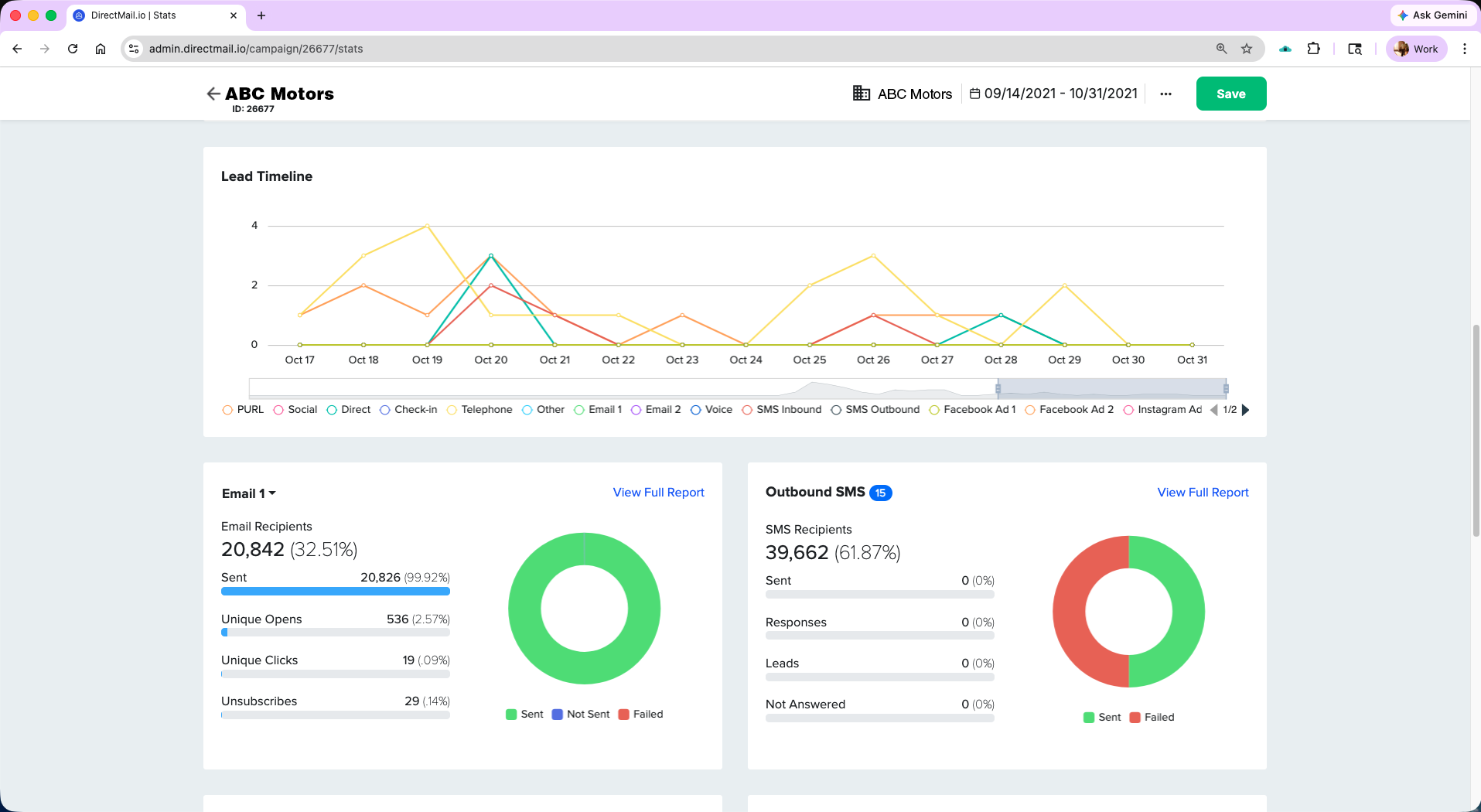
Templates across every vertical — mail, email, landing page, SMS, and trigger sequences all bundled. Start from a proven play, drop in the client’s data, launch the same day. No more quoting custom builds from scratch.
Every major vertical. Clone, brand, and launch — no custom build required.
Mail + email + SMS + landing page + follow-up sequence as one unit.
New-mover, birthday, USPS scan, and drip flows prebuilt and ready.
Mail piece, landing page, and email — one editor experience across all three.
Set your client brand once. Every template renders in their colors and logo.
Start from any template. Point at the list. Launch same-day.
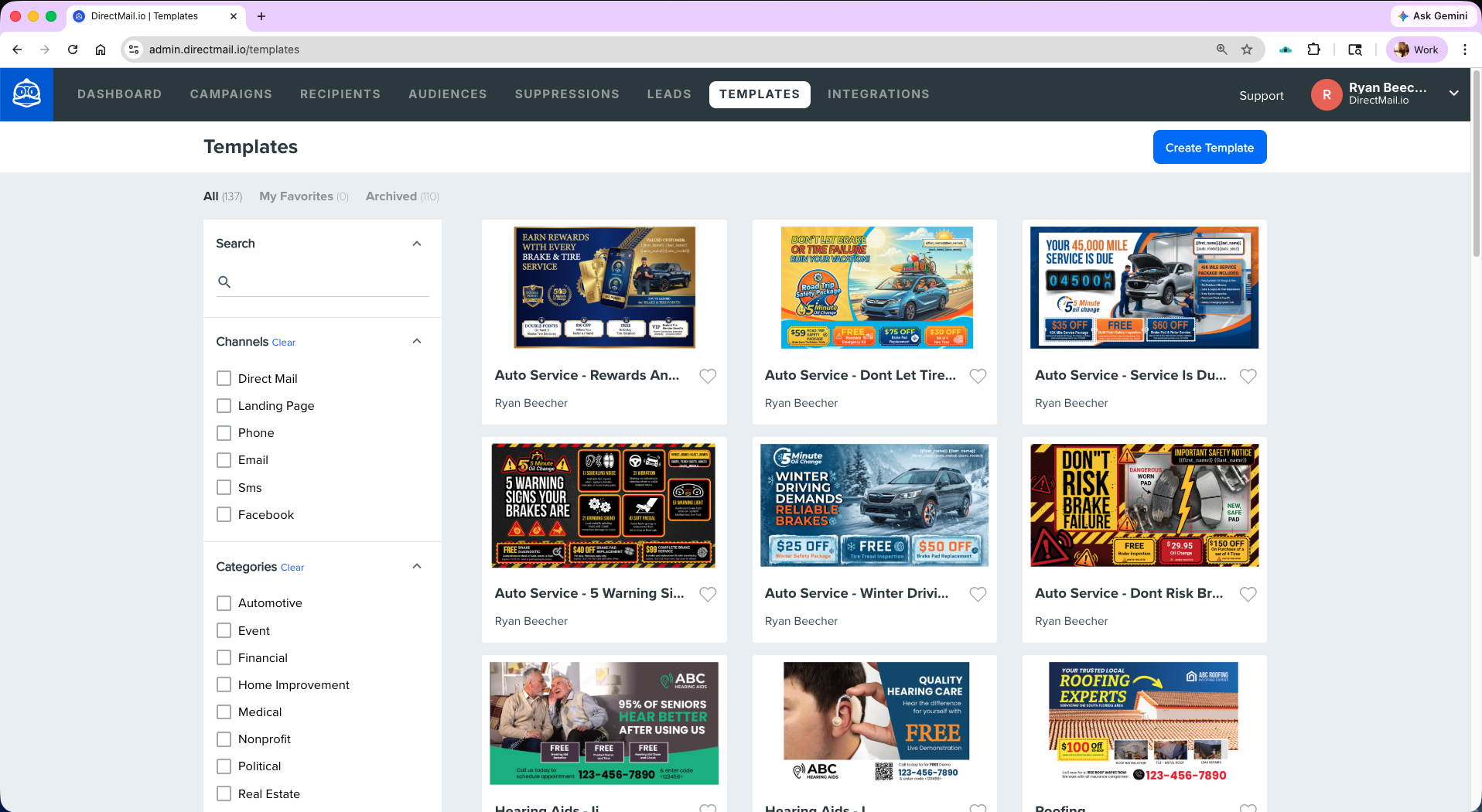
Set up once per client. Runs automatically on their calendar. USPS scan triggers, new-mover triggers, birthday/event triggers, drip sequences, and anonymous visitor identity resolution — all native.
Email or SMS fired on the real USPS last-scan event.
Fresh new-mover data, auto-targeted drops on a recurring schedule.
CRM-driven sends for anniversaries, purchase dates, and lifecycle events.
Coordinated across mail, email, SMS, and social. Set once, runs automatically.
Pixel identifies high-intent web visitors and triggers direct mail to them.
The three reasons agencies switch to DirectMail.io and stop looking.
One login replaces ten. Pre-built templates replace custom quotes. One campaign setup serves every channel, every client.
10 → 1 tools replacedReseller pricing keeps the margin with your agency. No integration costs to maintain. No cross-platform debugging eats your team's hours.
Margin stays yoursOmni-channel results clients cannot get elsewhere. Attribution they can show their boss. Better results = longer retention.
Retention by performanceThe short versions. For anything specific to your client book, book a demo — we'll answer live.
DirectMail.io is a white-label direct mail platform built for agencies. Sub-accounts let each client log into a branded workspace, so the platform appears to be your agency's own software. Pre-built campaign templates across every vertical mean new client launches take hours, not weeks. The full postal stack (NCOA, CASS, presort, drop ship, commingle, Informed Delivery, Informed Visibility) plus omni-channel (email, SMS, Meta, dynamic QR, retargeting) and attribution are all native — no integrations to stitch together.
No. Clients never see DirectMail.io branding. You set your agency logo, colors, and domain once — every sub-account, dashboard, and report renders under your brand. Clients log in at clients.youragency.com (or any subdomain you set). Emails, PDFs, and embedded widgets also carry your agency name.
Every client gets their own isolated workspace inside your agency account. Lists, campaigns, branding, and reporting stay separate per client. You get an agency-wide dashboard to manage all clients and move resources between them. Role-based access lets you invite client users with scoped permissions (view-only, approval-only, full editor, etc.).
The Reseller plan is DirectMail.io's agency plan. It includes unlimited sub-accounts, white-label branding, custom domain support, pre-built campaign templates, the full omni-channel and postal stack, automation triggers, and attribution. Pricing is wholesale based on volume, so you keep the margin when you resell to clients. Book a demo for exact pricing based on your client book and send volume.
DirectMail.io ships with campaign templates across every major vertical — real estate, home services, healthcare, automotive, financial services, franchise, and more. Each template includes the mail piece, matching email, landing page, SMS copy, and a trigger sequence. You clone a template, apply the client's branding preset, point it at their list, and launch same-day.
Yes. DirectMail.io integrates via SFTP, REST API, and webhooks (SOC 2 Type 2 certified). You can pipe campaign events into your CRM, sync leads back, trigger mail from CRM events, and export attribution data to whatever BI or analytics tool you already use. You do not have to replace anything — DirectMail.io replaces the ten direct-mail-specific platforms, not your agency stack.
Most new client launches happen in days, not weeks. Onboarding a new agency typically takes a week to set up branding, custom domain, and initial templates. Onboarding a new client under an existing agency account takes hours — clone a template, set the client brand preset, upload or connect the list, and launch.
Production runs through a nationwide two-sided network of vetted, certified printers. When an agency runs a campaign on the platform, every piece is automatically routed to a printer whose geographic coverage matches the recipient cluster. The agency does not run vendor RFPs, negotiate capacity, or onboard new printers as load grows. Mail prints local to each recipient, which captures USPS drop-ship postage economics on every qualifying drop and shortens delivery windows. The network handles production; the agency runs the campaign.
Yes. The network routes a single campaign to multiple printers based on the geographic distribution of the recipient list, so a campaign for a national client can print in five or ten cities simultaneously without the agency managing five or ten separate vendor relationships. One dashboard, one set of attribution data, one set of approvals.
Bring a client campaign you’d run. We’ll show you how it looks branded, templated, and set up for recurring sends.